


- 131 Views
- 3 Min Read
- (0) Comment
Facts About Mount Kailash
Mount Kailash, rising to about 6,714 meters in the remote plateau of Western Tibet, is one of the few mountains on earth that no human has ever climbed. For many pilgrims who travel from different parts of the world, this single mountain holds deep meaning.People begin the Kailash Mansarovar Yatra with the belief that a visit here can change the course of one’s life. Hindus, Buddhists, Jains and Bon followers all view this mountain differently, yet their devotion leads them to the same destination.
One of the most spoken-about features of Kailash is the 52-km parikrama that circles the entire mountain. This goes over the Dolma La Pass, which is around 5,630 meters, one of the highest points during the journey. The parikrama is usually completed in three days, but for many people, the moments spent at the top of Dolma La stay in memory forever.
Close to Mount Kailash lies Lake Mansarovar, at an altitude of about 4,590 meters. This lake is believed to have been created in the mind of Lord Brahma before taking physical form. Devotees take a holy bath, drink the water, or simply sit by the shore.Next to it is Rakshas Tal, a saltwater lake linked with legends. Though the two lakes lie side by side, they represent completely opposite energies, something which is very fascinating.
Another point often linked with Kailash is that it is the source of four major rivers which are the Indus, Sutlej, Brahmaputra and Karnali. These rivers feed large regions of Asia, and many people believe that this natural design adds to Kailash’s spiritual identity as the “center of the world.” Some scholars have compared this with ancient concepts of the universe where the center represents balance in nature. Though no confirmed conclusion exists, Kailash continues to be a subject of curiosity.
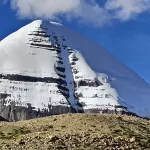
A lesser-known detail about the mountain is that it has a near-perfect pyramidal structure with four distinct faces facing the four cardinal directions. Local monks say that this shape is not accidental but a sign of natural alignment with cosmic forces. Travellers also speak about the unusual appearance of the mountain. This has led to many stories by yatris who describe Kailash as a living presence rather than just a peak.
Another interesting belief is that the mountain has never been climbed because it is not meant to be touched by human feet. Many explorers, including foreign mountaineers in previous decades, withdrew their plans after locals requested them not to disturb the sacred peak.
In one popular anecdote, a foreign climber who tried to explore the region later wrote that he felt a strong inner pull to retreat. It could be intuition also but the mountain remains untouched to this day.
The route to Kailash Mansarovar opens only for a limited time each year, usually from late spring to early autumn. Weather conditions can change quickly, and high-altitude travel requires physical fitness. Yet year after year, people come with the hope of inner peace. A common saying among pilgrims is, “You don’t go to Kailash; Kailash calls you.”
With its myths, landscapes and mysteries, Mount Kailash continues to be a place where question and belief walk side by side. Anyone who sets foot on this path carries back a story to remember.


 WhatsApp
 Enquiry
 Call
Call
Leave a comment: